Blog

  • Compliance: Gain a Competitive Edge

    Competitive Edge

    Businesses are tasked daily to increase revenue and maintain profit margins. With today’s economy a competitive edge no matter how minuscule can be the difference between a win and a loss. We see this in retail, in the job market, in manufacturing and now in security and compliance.

    I know. It’s hard to even think of the money spent on compliance as any kind of competitive advantage. But stop for a moment. There are two factors here: First, continuous compliance reduces the cost of being compliant. Second, by ingraining continuous compliance into our business culture it erases the perceived burden. If we changed our approach to security and compliance and made it less about passing the audit and more about business strategy and protecting the organizations information assets the competitive edge is much clearer. By protecting our customer data we are telling our customers that we value them.

    (more…)
  • Compliance as Security: The Root of Insanity

    December 08, 2009CSO

    There is an ever-increasing pressure for security executives to be a champion of compliance within their respective organizations. Given that there seem to be new or changing compliance requirements emerging on a fairly regular basis, this can be viewed as both a blessing and a curse.

    As our government acquires increasing financial interests in some private business sectors, this trend may continue to escalate.

    The blessing is that in some instances it gives the security function some additional leverage to drive results and deliver greater overall value. The curse is that the regulatory compliance requirements just add to the already voluminous amount of reactionary items that already exist on the security executive’s plate. The security function is an area of responsibility that already has far too many variables that cause reactionary behavior if permitted. In some organizations this additional set of variables can be the straw that breaks the camel’s back.

    Great article from CSO magazine talking about how organizations just chase their tails with the regulatory framework of the month and should instead build a information security framework that is more comprehensive and proactive.

  • Nation & World | McCain, Cantwell sponsor bank bill | Seattle Times Newspaper

    Originally published December 17, 2009 at 8:09 PM | Page modified December 17, 2009 at 9:58 PM

    McCain, Cantwell sponsor bank bill

    Two senators, including Washington state Democrat Maria Cantwell, have called for breaking up large financial firms that perform both commercial and investment banking, adding a wrinkle to already difficult Senate talks on how to regulate Wall Street.

    By The Associated Press and Bloomberg News

    Sen. Maria Cantwell


    Sen. Maria Cantwell

    WASHINGTON — Two senators, including Washington state Democrat Maria Cantwell, have called for breaking up large financial firms that perform both commercial and investment banking, adding a wrinkle to already difficult Senate talks on how to regulate Wall Street.

    Cantwell and Sen. John McCain, R-Ariz., on Wednesday introduced legislation that would bar commercial banks from undertaking brokerage activities. Democrats introduced a similar bill in the House.

    Such a ban, a reinstatement of the Depression-era Glass-Steagall Act, which was repealed a decade ago, would strike directly at such institutions as Goldman Sachs, JPMorgan Chase, Citigroup, Bank of America and Wells Fargo, which engage in both commercial and investment banking.

    “Banks need to be lending to small businesses and homeowners, not fueling risky Wall Street investment schemes,” McCain said. “We must return stability, security and confidence to commercial banking for the American public.”

    Under the Senate legislation, financial firms operating commercial banks and investment houses would have to decide whether to focus on commercial banking or investment banking. Commercial banks would be banned from engaging in insurance activities.

    A former bank regulator quickly criticized the proposal.

    “Trying to split them up is crazy,” said John Douglas, a former Federal Deposit Insurance Corp. general counsel who leads the bank regulatory practice at Davis Polk & Wardwell in New York. “The integration of the securities and banking function came about because of the need of large corporate customers to have integrated banking and securities services.”

    Cantwell, however, noted that Wall Street firms are poised to post soaring end-of-year profits and bonuses, while Main Street continues to suffer.

    The president of the Independent Community Bankers of America said a growing realization has emerged in Congress the repeal may have been a mistake.

    “We cruise along for 80 years without a major calamity infecting the entire financial system, and then less than eight years after the repeal of Glass-Steagall we have a financial meltdown in this country,” said Camden Fine, president of the Washington, D.C.-based trade group for about 5,000 smaller U.S. banks. “That’s no accident.”

    Rep. Maurice Hinchey, D-N.Y., introduced a version of the bill a day after House Majority Leader Steny Hoyer told reporters that renewal of Glass-Steagall is under discussion.

    The House last week passed a bill that would overhaul U.S. financial rules in response to last year’s $700 billion taxpayer-funded bank bailout and in an effort to prevent future crises. The legislation included government authority to break apart large, healthy firms whose size threatens the economy and to seize and unwind failed companies whose collapse in bankruptcy could disrupt the financial system.

    In the Senate, members of the Banking Committee are crafting similar legislation, incorporating ideas proposed in June by President Obama. Cantwell said she and McCain will try to advance their legislation even if it’s not incorporated into the Senate financial overhaul bill.

  • Back to the Books: 2010 is the Year for New Skills, Certifications

    Back to the Books: 2010 is the Year for New Skills, Certifications

    Career Trends Survey Taps Risk Management, Cybersecurity, Fraud/Forensics as Growth Areas Across Industries

    What will be the hot information security jobs in 2010?

    How will professionals grow their skills – and will their employers foot the bill?

    What are the minimum academic and professional requirements for information security professionals and leaders today?

    These are among the key questions posed by the first annual Information Security Today Career Trends survey. The goal of the research: to create the benchmark for information security careers – where the jobs are and what’s required to fill them.

    The challenge: to create this benchmark at a time when the economy is recovering, the threat landscape is shifting and organizations are re-setting their information security priorities.

    But then this survey also takes advantage of a unique opportunity: Led by President Obama, the U.S. has embraced cybersecurity as a national priority, and as such the nation’s businesses, academic institutions and government agencies are focused as never before on information security and assurance. There is no better time to benchmark information security careers. And, frankly, there might not be a better time to start – or re-start – one.

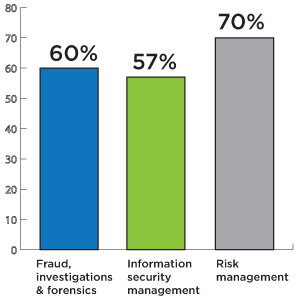
    Where do you expect to see the greatest need for new information security professionals in 2010 and beyond


    When asked “which industry-recognized certifications do you feel necessary and/or plan to pursue in the next year.”, 30% said CISSP, 22% said CISM and 19% said GIAC., according to the Career Trends Survey performed by ISMG in September, 2009. http://bit.ly/7suB5n

  • Tech demands of a new generation of consumers to reshape retail banking

    Ongoing investment in technology by the retail banking sector is essential if the industry is to win the business of a maturing generation of tech-literate consumers who are forsaking traditional physical channels in favour of online consumption of financial products.

    Separate studies of Gen Y consumers (those aged between 21 and 29 years of age) by Fiserv and Cisco reveal an up-and-coming generation of fiscally responsible young adults who are more comfortable operating in a digitally-connected environment than preceding generations.

    Members of Gen Y are frequent users of online and mobile financial services, the research finds, are more likely to have debit cards and savings accounts than any other generation, and rely heavily on other people and online information when making financial product decisions.

    See the rest at Finextra.com
  • RiskKey to showcase at FinovateSpring 2010

    Finovate2010

    We’re excited to announce the RiskKey is going to be showing its stuff on May 11th in San Francisco at the hottest financial technology conference of the year, FinovateSpring2010! We have 7 minutes to show off what’s great about RiskKey and no Powerpoint slides allowed. We’re humbled by being selected and hope to put next generation compliance app on the map!

    Here’s a press release of our announcement!

  • Webinar – Top Security Threats of 2011

    Thanks to all that were able to attend our webinar last Friday on Top Security Threats of 2011. We, once again, apologize for the technical issues and even though we love our technology, it can always be unpredictable. And thanks again to Eric Kitchens for presenting for the webinar this month, great job Eric! If you have follow-up questions for Eric, feel free to contact him at eric [at] thegarlandgroup [dot] net.

    (more…)
  • Compliance Culture Profiles – Which one are you?

    When we first talk with a financial institution we find out certain key components that make up the FI’s DNA. One of those is their ‘culture of compliance’. And generally, within only a few minutes, we can tell how that FI feels about the compliance process. We are curious of things like, “Will they see value in what we provide?” “Are they able to handle the scope we work through?” “Is this a client we really want to work with or will it be a painful process for both sides?” You see we found that there are really two main profiles that we run across and here’s a list of how each one will think:

    The Penny Pinchers

  • Whatever it takes to get past the federal exam. Maybe we can get past without a 3rd party audit all together? Hmm…
  • Audit and compliance really only needs to be one persons responsibility.
  • What? The auditors want to use software to do their audits? Tell them to just make it work with M$ Office.
  • As long as we put a title on these policies and procedures we’re good. We don’t really need to follow them.
  • We don’t care of the providers reputation, the scope of work, we just need it cheap.
  • (more…)